The DfE’s Six Core Digital and Technology Standards: A Complete Guide for Schools and Trusts


From 29 June 2026, the guidance on mobile phones in schools became part of the Children’s Wellbeing and Schools Act 2026, and schools are expected to be following it from 1 September 2026. In short: state-funded schools in England now have a legal duty to have regard to government guidance stating that “all schools should be mobile phone-free environments by default.” Ofsted is also assessing phone policies as part of routine inspection.
For many schools, having a written policy is the easy part. Enforcing it consistently, fairly, and without turning every lesson change into a confiscation battle, is the real challenge. That’s where Yondr comes in.
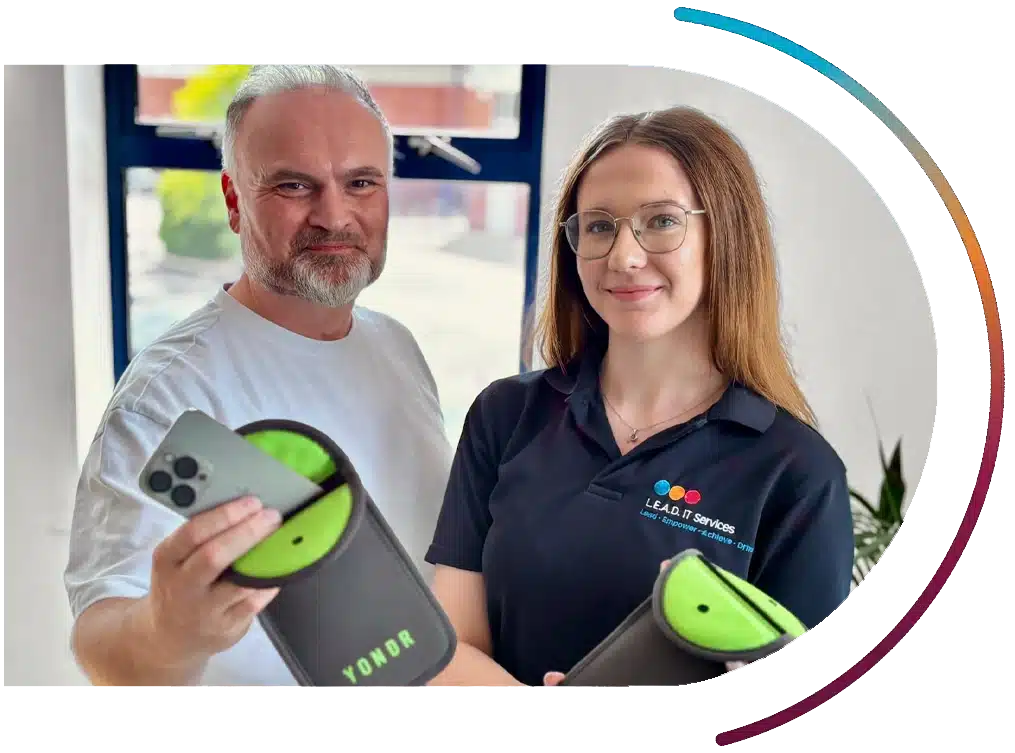
L.E.A.D. IT Services supplies and supports Yondr – the lockable phone pouch system trusted by schools, universities, courts and venues worldwide – giving Derby and Derbyshire schools and Multi Academy Trusts a straightforward, low-friction way to go phone-free without confiscating devices or relying on willpower alone.

The Association of School and College Leaders has been clear that schools need practical support — not just guidance – to make phone-free days work in reality. That means lockers, secure storage, or pouch-based systems that remove the daily flashpoint of staff physically taking phones off pupils.
A written rule says phones aren’t allowed. A Yondr phone pouch makes that rule self-enforcing, consistent and dignified – for pupils, staff and parents alike.

Yondr’s system is simple, and that’s exactly why it’s effective in a school setting.
L.E.A.D. IT Services supplies and supports Yondr phone pouches – the lockable phone pouch system trusted by schools, universities, courts and venues worldwide – giving Derby and Derbyshire schools and Multi Academy Trusts a straightforward, low-friction way to go phone-free without confiscating devices or relying on willpower alone.
Yondr was founded in 2014 in San Francisco and has since become the established global leader in creating phone-free spaces — used in schools, comedy clubs, concert venues, courts and workplaces across multiple countries. Schools represent one of Yondr’s largest and longest-running use cases, with the same pouch technology refined over a decade of real-world classroom use.

A proven product, not a new or unproven solution rushed out in response to a legal change
Durable, reusable pouches designed for daily wear and tear across a full school year
No confiscation required – pupils keep their own phones in their own Yondr phone pouches
Consistent enforcement across year groups, removing inconsistency between staff and classrooms
A visible compliance step that supports Ofsted’s expectation that schools demonstrate effective implementation, not just a policy on paper
% saw an improvement in student engagement in the classroom.
% saw an improvement in student behaviour.
% saw an improvement in academic performance.
Buying Yonder phone pouches is the easy part. Rolling them out across a school — or consistently across every school in a Trust – is where the real value of working with a managed IT and safeguarding partner comes in.

Working out pupil numbers, entry/exit points and the right rollout model for your site

Sourcing the right quantity and configuration of pouches and unlocking bases

Helping you design a workable daily process for arrival, lock and unlock points

Materials to help your team explain the system to pupils and parents

Replacement pouches, troubleshooting and advice as your policy beds in
Integration into your wider safeguarding approach – alongside platforms like StudentKeeper
and Human Review, so device safeguarding, online filtering and physical phone-free compliance work as one joined-up strategy rather than three separate initiatives
This means your phone-free policy isn’t just compliant on paper – it’s genuinely embedded, supported and sustainable.
Because we already work inside your school’s wider IT, safeguarding and compliance environment, we’re positioned to help phone-free implementation succeed rather than treating it as a one-off purchase.
We understand school timetables, site layouts and safeguarding obligations
Rather than managing a separate supplier relationship outside your existing IT support
The same rollout standard and support model across every school in your MAT
From 29 June 2026, government guidance on mobile phones in schools was given legal force under the Children’s Wellbeing and Schools Act 2026, with schools expected to be following it from 1 September 2026. State-funded schools in England now have a duty to have regard to this guidance, which states that schools should be mobile phone-free environments by default. Ofsted assesses schools’ mobile phone policies as part of routine inspection.
No — the law requires schools to have an effective policy preventing pupil access to phones during the school day, but it does not mandate a specific method. Pouches are one of the most practical and widely adopted ways to enforce a phone-free policy consistently, without resorting to mass confiscation or relying on individual staff judgement lesson by lesson.
With Yondr phone pouches, pupils keep their own phone, inside their own pouch, with them at all times – it is simply locked and cannot be used until unlocked at an authorised point. This avoids the safeguarding, lost-property and parental-access concerns associated with staff physically taking phones away from pupils.
Yes. Because the phone stays with the pupil inside the locked pouch, it is still physically present – it simply cannot be used until the pouch is unlocked. Schools can also build exceptions into their policy for pupils who need phone access for medical reasons, in line with their duties under the Children and Families Act 2014.
No. Schools can use Yondr phone pouches for the full school day, for specific lessons, for exams, or for particular events such as trips and assemblies, depending on what their policy requires.
Yes. We work with MATs to design a consistent rollout approach across every school in the Trust, supported by the same procurement, implementation and ongoing support model we use for our wider managed IT and safeguarding services.
Yes. Yondr addresses physical phone-free compliance, while platforms like StudentKeeper handle device filtering and monitoring. Delivered together through L.E.A.D. IT Services, they form a single, joined-up safeguarding strategy rather than separate, disconnected tools.