The DfE’s Six Core Digital and Technology Standards: A Complete Guide for Schools and Trusts

For the past few years, most schools in England have already been operating some form of mobile phone policy. From 29 June 2026, that guidance stopped being advisory and became law.
Under the Children’s Wellbeing and Schools Act 2026, state-funded schools now have a statutory duty to have regard to government guidance on mobile phones – guidance that states schools should be ‘mobile phone-free environments by default’. Schools are expected to be following the guidance from 1 September 2026, and Ofsted has confirmed it will assess schools’ mobile phone policies, and how well they’re actually implemented, as part of routine inspection.
For school leaders and Trust Operations teams, this raises a practical question: is your current approach genuinely ready for that level of scrutiny?
Announcing the change in the House of Lords, Education Minister Baroness Smith of Malvern confirmed the government would table an amendment ‘creating a clear legal requirement for schools’ on mobile phone use. Education Secretary Bridget Phillipson has also written directly to headteachers, arguing that the previous, non-statutory approach ‘did not deliver the clarity or consistency that schools need.’
The expectation is straightforward in principle: pupils should not have access to their mobile phone (or similar smart devices) at any point during the school day – not just in lessons, but between lessons, at break and at lunchtime too.
There’s a sensible exception built in. Where a pupil needs a mobile phone to manage a medical condition – for example, a continuous glucose monitor linked to a phone for a pupil with diabetes – schools are expected to allow it. Beyond that, the guidance is clear that exceptions should be the exception, not the norm.
Crucially, the policy itself can sit within your existing behaviour policy or stand alone, but it needs to be clear, consistently applied, and properly understood by pupils, staff and parents. A document that exists but isn’t reliably followed in practice won’t hold up well at inspection.
This is the part many schools are still working through. The Association of School and College Leaders has been vocal that schools need genuine practical support to make phone-free days work – not just a clearer rule. ASCL general secretary Pepe Di’Iasio has called for funding to help schools go beyond a basic “no see, no hear” approach, pointing specifically to the cost of “lockers, secure storage areas or phone pouches.”
It’s easy to see why. Asking staff to physically confiscate phones from pupils, lesson after lesson, creates friction, inconsistency between classrooms, and a steady stream of lost-property and parental-access complaints. A policy that depends entirely on individual staff vigilance rarely survives contact with a real school day.
Ofsted’s involvement raises the stakes further. Inspectors aren’t just checking that a policy document exists – they’re forming a view on whether it’s actually working day to day.

Most schools considering implementation are weighing up a small number of approaches:
Of the three, pouch-based systems tend to be the lowest-friction option for staff and the easiest to apply consistently across an entire school or Trust, because they remove the daily confiscation flashpoint altogether.
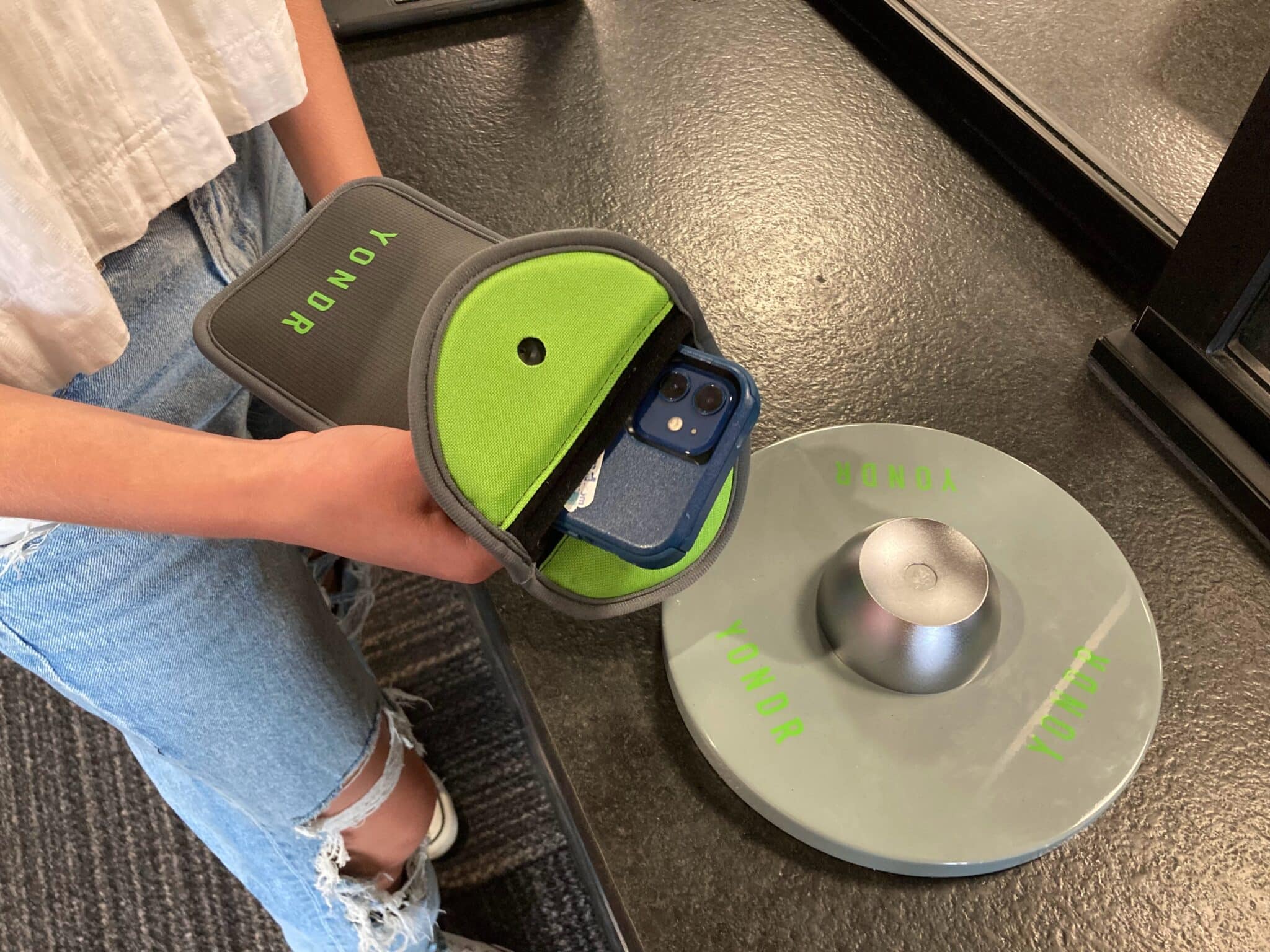
Phone-free compliance doesn’t sit in isolation – it’s part of the same safeguarding and governance picture as your filtering, monitoring and device strategy. As part of our Safeguarding and Filtering service, we help schools and Multi Academy Trusts move from ‘we have a policy’ to ‘we have a policy that works’, supplying and supporting Yondr lockable phone pouches alongside platforms like StudentKeeper and Human Review.
Schools have had years to get a phone policy on paper. What we’re hearing from leaders now is a much more practical question – how do we actually make it stick, every lesson, every day, without it falling on staff to police it. That’s exactly the gap Yondr pouches are designed to close, and it’s why we’re helping schools build that into their wider safeguarding approach rather than treating it as a standalone purchase.
Chris Edwards, Partnership Development Manager – L.E.A.D. IT Services
If you’d like to talk through what compliant implementation looks like for your school or Trust, find out more about the system or book a consultation, get in touch with the team.

This is the approach we deliver and support through L.E.A.D. IT Services, using Yondr – the lockable pouch system already used in schools, universities and venues worldwide. It’s a simple three-step process:
Because pupils keep physical possession of their own device throughout, there’s no confiscation, no lost property, and no daily standoff between staff and pupils – just a consistent, dignified routine that’s easy for everyone to follow and easy for leadership to evidence at inspection.
Full details on the system, rollout and ongoing support are on our Yondr phone pouches for schools page