Watch: What should schools ask their IT provider?
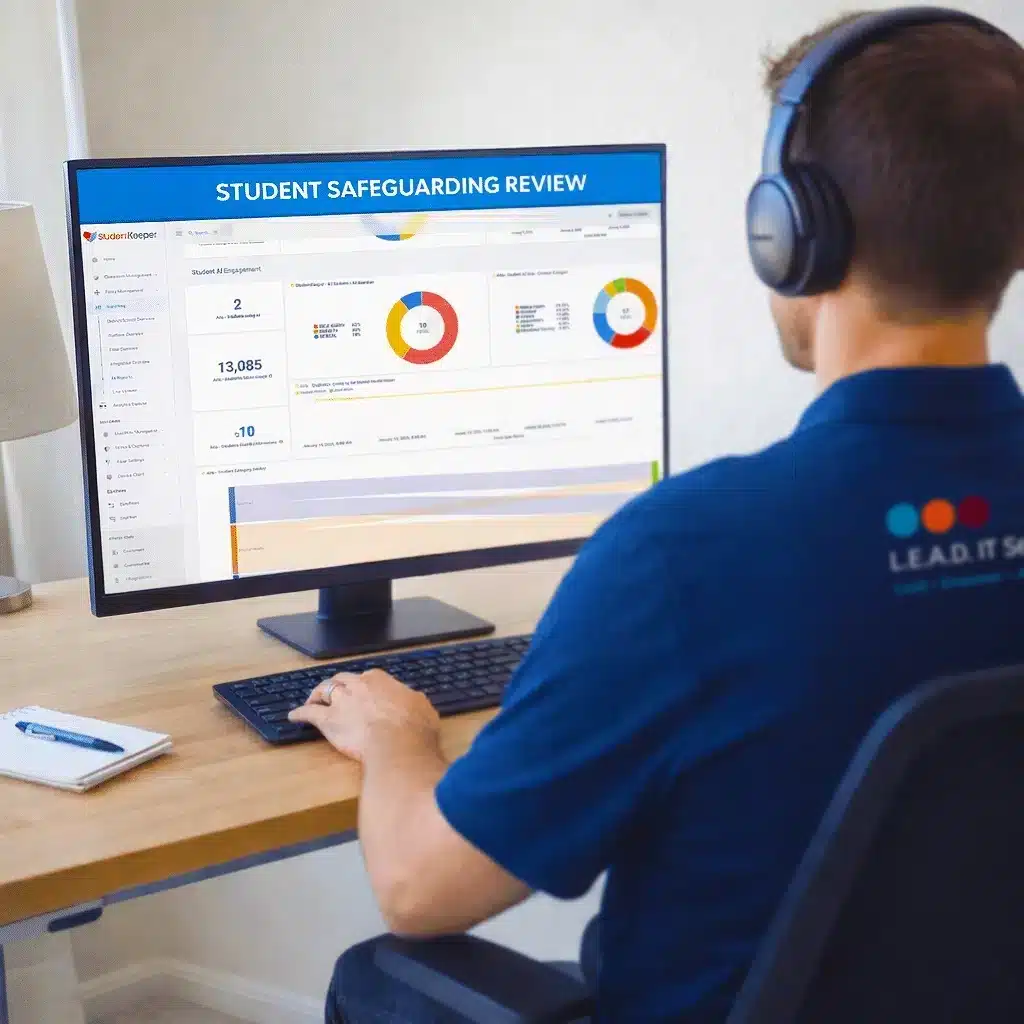
Every day, across schools and Multi Academy Trusts throughout the UK, filtering and monitoring systems are generating safeguarding alerts. Hundreds of them. Sometimes thousands. Each one representing a moment where a student searched for something, visited somewhere, or typed something that a system decided warranted attention.
The question isn’t whether those alerts are being generated. The question is – what happens to them next?
For many Designated Safeguarding Leads, the honest answer is uncomfortable. Alerts are reviewed when time allows. Some are assessed quickly. Others sit in a queue. And in the middle of a busy school day – with lessons to cover, parents to call, and an ever-growing list of responsibilities – the idea of working through a backlog of system-generated notifications can feel overwhelming before it has even begun.
This is the reality of school safeguarding in 2026. And it’s a reality that automated technology alone cannot solve.
Filtering and monitoring platforms are essential. No serious safeguarding approach should be without them. They identify potential risks in real time, surface concerning behaviour, and create a record of online activity that schools can use to support vulnerable students.
But a system can only tell you that something happened. It cannot tell you what it means.
Technology is a brilliant first line of defence – but it has no human judgement. It doesn’t know that the student who searched those terms is going through a difficult time at home, or that the same search from a different student might mean something else entirely. That context is everything in safeguarding, and only a trained professional can provide it.
– Chris Edwards, L.E.A.D. IT Services
This is the gap that Human Review exists to fill. Between the alert that a system generates and the action that a safeguarding team takes, there is a critical layer of interpretation – one that requires expertise, experience and an understanding of what genuine risk looks like in a school environment.
Without that layer, schools face two equally serious problems. The first is missing something important – a pattern of behaviour, an escalating concern, a child who is reaching out in the only way they know how. The second is the opposite; alert fatigue. A DSL drowning in notifications, unable to distinguish the urgent from the routine, spending hours on data analysis when they should be spending that time with the children who need them.

Alert fatigue is not a minor inconvenience. In a safeguarding context, it is a genuine risk.
When the volume of alerts exceeds the capacity of a team to review them meaningfully, standards inevitably drop. Reviews become less thorough. Categorisation becomes less consistent. And the risk that something serious is overlooked – filed under ‘low priority’ or left in a queue over a weekend – increases with every alert that goes unread.
DSLs are receiving hundreds of alerts each week. They’re committed, dedicated professionals – but no one can sustain that level of volume without support. Alert fatigue isn’t a reflection of their ability. It’s a reflection of a system that’s asking too much of one individual person.
The consequences of a missed safeguarding concern are serious – for the child, for the school and for the individuals who carry safeguarding responsibility. Human Review directly addresses this. By placing trained professionals between the alert and the DSL, it ensures that what reaches your safeguarding team is already assessed, categorised and prioritised – so they can focus on the concerns that genuinely require their expertise and their time.
If alert fatigue is the challenge during the school day, out-of-hours activity represents an even more acute problem.
Research into young people’s technology use consistently shows that evening and weekend device use is where risk most often escalates. A student in difficulty is more likely to search for harmful content, reach out in concerning ways, or exhibit patterns of worrying behaviour when they are at home, unsupervised and away from the support structures that school provides.
And yet, for most schools, safeguarding monitoring effectively switches off when the last member of staff leaves the building.
Full 24/7 Human Review means that alerts generated at any hour are assessed by a trained professional in real time. High-risk concerns are escalated immediately to the designated safeguarding lead, giving schools the opportunity to act before a situation deteriorates further. For many of the schools and trusts L.E.A.D. IT work with, this out-of-hours capability is the element of Human Review that resonates most strongly – because it addresses a vulnerability that, until now, most had accepted as unavoidable.
It isn’t.
Keeping Children Safe in Education (KCSIE) is unambiguous on the subject of online monitoring. Schools are expected not only to have appropriate filtering and monitoring in place, but to be able to demonstrate that what is identified is reviewed, assessed and acted upon effectively.
For Ofsted, this means evidence. A school that can show alerts were generated but cannot demonstrate a structured, consistent response to those alerts is not meeting the standard that KCSIE sets – regardless of how good its technology is.
KCSIE doesn’t just ask schools to monitor – it asks them to act. And acting on an alert means understanding it first. Human Review is what turns a monitoring system into a genuinely compliant safeguarding process.
– Chris Edwards, L.E.A.D. IT Services
Human Review creates the audit trail that KCSIE compliance requires. Every alert is reviewed, categorised and documented. Every escalation is recorded. Every action is evidenced. When an inspector asks how your school responds to safeguarding alerts, the answer is clear, structured and demonstrable – not dependent on the memory of an overstretched DSL trying to recall what happened three months ago.
For Multi Academy Trusts, the challenges outlined above are multiplied across every school in the organisation. Individual sites have different DSLs, different student populations, different risk profiles and different processes – whilst the Trust as a whole carries responsibility for the safeguarding standard at every one of them.
Without consistent, centralised oversight, the safeguarding quality across a Trust can vary significantly from school to school. A strong DSL at one site may be managing alerts thoroughly and consistently. At another, capacity issues, staff changes or high alert volumes may mean the process is less robust.
Trusts tell us that one of their biggest concerns is not knowing what they don’t know. Human Review changes that. It gives Trust leaders visibility and confidence across every site – not because they’re looking over their DSLs’ shoulders, but because there’s a consistent, professional layer of oversight that every school in the Trust benefits from equally.
– Chris Edwards, L.E.A.D. IT Services
L.E.A.D. IT Services delivers Human Review in a way that works at both school and Trust level – with consistent review standards across every site, school-specific escalation pathways, and Trust-wide reporting that gives senior leaders the oversight they need to fulfil their governance responsibilities.
The best safeguarding approaches share certain characteristics. They are proactive, not reactive. They are consistent, not dependent on any individual’s capacity on any given day. They create clear records and clear processes. And they allow the people who are closest to students – the DSLs, the pastoral teams, the teachers – to focus on the human work of supporting children, rather than the administrative burden of managing data.
Human Review is not a replacement for any of that. It is the layer that makes all of it more possible.
When alerts are reviewed by trained professionals, categorised consistently and escalated with clear information and recommended actions, safeguarding teams can do their jobs better. Not because the technology has replaced their expertise – but because it has freed them to use it.
If your DSL is spending significant time reviewing and triaging alerts, if your school’s monitoring extends only to the hours when staff are present, or if you are uncertain whether your current approach would satisfy an Ofsted inspection – it may be time to consider whether Human Review could strengthen your safeguarding provision.
Talk to our safeguarding team about Human Review:
Filtering and monitoring technology has transformed the way schools approach online safeguarding. But having a system that generates alerts is only half of the picture. The question every DSL, Headteacher and MAT leader should be asking is not just ‘are we monitoring?’ – it is ‘are we responding effectively to everything we find?’
For many schools, the honest answer reveals a gap. Here are ten signs that Human Review could be the missing layer in your safeguarding approach.
If your Designated Safeguarding Lead is regularly working through alert queues – assessing, categorising and deciding what requires action – that time is coming from somewhere else. The direct, human work of safeguarding; talking to students, supporting vulnerable individuals, working with families and external agencies. When alert triage becomes a significant part of a DSL’s week, it is a sign that the process is working against them rather than for them. Human Review reclaims that time by placing trained professionals between the alert and the DSL – ensuring what reaches your safeguarding lead is already assessed, prioritised and ready to act on.
If your filtering system generates alerts around the clock but your review process only operates during school hours, you have a gap that could have serious consequences. Research consistently shows that young people are most active online in the evenings and at weekends – and that some of the most concerning behaviour, from self-harm searches to contact with unknown adults, happens precisely when school-based support is not available. If a high-risk alert generated at 9pm on a Friday is not reviewed until Monday morning, the window for early intervention has already closed. 24/7 Human Review ensures that coverage never lapses – regardless of the time, day or term.
Alert fatigue is one of the most underacknowledged risks in school safeguarding. When reviewers – whether DSLs or support staff – are confronted with high volumes of alerts on a regular basis, the quality and consistency of reviews inevitably decline. Patterns get missed. Low-risk and high-risk alerts begin to blur. The process becomes a task to get through rather than a genuine safeguarding activity. If anyone in your team has described the alert queue as overwhelming, or if reviews are regularly deferred to make time for other priorities, alert fatigue has already taken hold. Human Review breaks that cycle.
Ofsted’s safeguarding inspection framework is clear; schools must not only have appropriate filtering and monitoring in place, but must be able to demonstrate that what is identified is acted upon. If your last inspection resulted in any commentary around the consistency, documentation or timeliness of your safeguarding response to online monitoring alerts, that is a direct signal that your current process has gaps.
Human Review provides the structured, documented, consistent response that inspection frameworks require – and creates the audit trail that gives both your leadership team and your inspectors confidence that nothing is being missed.
If someone asked you today to produce a complete record of every safeguarding alert your school received in the last term – together with how each one was assessed, what category it was assigned, and what action was taken – how confident would you be in your answer? For many schools, the honest response is ‘not very’. Incomplete or inconsistent audit records are one of the most common safeguarding governance weaknesses, and one of the most straightforward for an inspector to identify.
Human Review creates a structured, comprehensive record for every alert reviewed – making your audit trail complete, consistent and always available.
In a Multi Academy Trust, safeguarding quality should not vary depending on which school a child attends. But without centralised oversight and consistent processes, that variation is almost inevitable. Different DSLs bring different levels of experience. Alert volumes differ between sites. Capacity fluctuates with staffing changes and absence.
If your Trust cannot confidently say that every school in your family meets the same standard of safeguarding oversight – and can evidence it – then the gaps in your least well-resourced schools represent real risk for the children in those settings. Human Review delivers consistent standards across every site, regardless of local capacity.
Safeguarding continuity is fragile. When a DSL moves on, takes extended leave or changes role, the institutional knowledge they carry – awareness of individual students, familiarity with your filtering platform, understanding of escalation processes – does not automatically transfer to their successor. In the period of transition, alert review quality can decline significantly, and the risk that something important is missed is at its highest.
Human Review provides a consistent, professional layer of oversight that operates independently of internal staffing changes – ensuring your safeguarding process does not fluctuate with your team.
Every new device in a student’s hands is a new potential source of safeguarding alerts. Schools that have significantly expanded their device programmes – whether through 1:1 schemes, BYOD policies or post-pandemic digital investment – often find that their safeguarding processes have not scaled accordingly.
More devices mean more monitoring data, more alerts and more demand on the team responsible for reviewing them. If your alert volumes have grown faster than your capacity to respond to them, Human Review provides the scalable layer of expertise that keeps pace with your digital environment.
The most serious safeguarding situations rarely begin with a single, obviously high-risk alert. More often, they develop through a pattern – a series of searches, a recurring theme, a gradual shift in behaviour that, individually, might not trigger concern but collectively paints a worrying picture.
If your current process reviews alerts in isolation rather than tracking patterns across time and across a student’s history, you may be missing the early signals that would allow you to intervene before a situation escalates.
Human Review applies a consistent, contextual lens – looking not just at what was flagged today, but at what it means alongside everything that has been flagged before.
For some schools and trusts, the most honest answer to the question ‘is our safeguarding process working?’ is ‘we are not sure.’ Perhaps the process has evolved organically rather than being deliberately designed. Perhaps responsibility has shifted between staff members without a formal handover. Perhaps the system is generating alerts that nobody is entirely certain are being managed consistently.
If uncertainty – rather than confidence – is the dominant feeling when your leadership team discusses safeguarding monitoring, that is itself a sign that the process needs strengthening. Human Review replaces uncertainty with structure, consistency and a clear evidential record that every alert has been seen, assessed and acted upon.

If any of these signs apply to your school or trust, we would welcome a conversation.
L.E.A.D. IT Services delivers Human Review as part of a fully integrated safeguarding and filtering service, working alongside StudentKeeper and your existing systems to ensure every alert is seen, understood and acted upon – at any hour, on any day.
Talk to our safeguarding team about Human Review:
When schools and trusts are evaluating a new safeguarding service, the questions that matter most are rarely the ones answered on a product page. They are the specific, practical, sometimes difficult questions that come from people who take safeguarding seriously and want to understand exactly what they are committing to.
Chris Edwards of L.E.A.D. IT Services answers twelve of those questions directly – with the detail and honesty that the subject deserves.
This is one of the most important questions to ask – and to answer clearly. Human Review does not, under any circumstances, replace your DSL or transfer safeguarding responsibility away from your school. Statutory responsibility for safeguarding remains exactly where it belongs; with your Designated Safeguarding Lead, your Headteacher and your governing body. That cannot be outsourced, and we would never suggest otherwise.
What Human Review does is remove the most time-consuming and technically demanding part of the alert management process – the initial review, assessment and categorisation of every alert your monitoring system generates – and places that in the hands of trained professionals so that your DSL receives clear, prioritised, actionable information rather than raw data.
Your DSL remains in control at every point. Every escalation comes to them. Every record is available to them. Human Review is their support system – not their replacement.
Every member of our Human Review team holds recognised safeguarding training appropriate to the level of assessment they are carrying out, and is DBS checked to the enhanced level required for work with children.
Our team’s training is aligned to the safeguarding frameworks applicable to schools in England, including KCSIE, and is refreshed regularly to reflect updated guidance and emerging risk areas. This is particularly important given how quickly the online risk landscape shifts – new platforms, new terminology, new types of harmful content – and our reviewers stay current with those changes as a core part of their professional practice.
One of the genuine advantages of being part of the L.E.A.D. Academy Trust is that our team works within a real educational environment every day. They are not reviewing alerts in isolation from a call centre – they understand the context of a school, the pressures on a safeguarding team, and the real-world consequences of the decisions they are helping to inform.
This is exactly the scenario that our 24/7 Human Review service is designed for – and it is one of the most important questions to ask of any provider offering out-of-hours coverage.
When a high-risk alert is generated at any hour, our on-duty reviewer assesses it in full, applies our risk categorisation criteria, and where the alert meets the threshold for immediate escalation, contacts your designated safeguarding lead directly. The method of contact – telephone, SMS, email, or a combination – is agreed with you as part of your service setup, and we work with you to define the escalation contacts and communication preferences that fit your school or trust’s structure.
We do not queue high-risk out-of-hours alerts for morning review. The entire purpose of 24/7 coverage is that a trained professional is available to make that assessment and initiate that contact at any point – because the child whose alert was generated at 2am on a Saturday cannot wait until Monday morning for someone to act.
Our on-duty reviewers are experienced, trained to operate independently under the defined criteria, and supported by a clear escalation process within our own team for cases where additional input is needed before contacting the DSL. Every out-of-hours review and escalation is fully documented in real time, with timestamps, review notes and action records that form part of your complete audit trail.
Safeguarding data is Category 1 sensitive personal data under UK GDPR, and we treat it with the rigour that classification demands. L.E.A.D. IT Services is Cyber Essentials certified, and our data handling processes are designed specifically for the sensitivity of safeguarding information.
Alert data reviewed by our team is processed under a formal data processing agreement that defines precisely how it is handled, stored, accessed and retained. Our reviewers access only the information necessary to carry out the review – no broader student data, personal records or school systems are accessible to them beyond the alert context required for assessment. Access controls, audit logging and data minimisation principles are applied throughout.
Data is processed and stored within the UK, and we do not use third-party subprocessors for the review function itself. Our retention policies are aligned to the guidance applicable to safeguarding records in schools, and we work with your Data Protection Officer or nominated lead to ensure our processing activities are accurately reflected in your Records of Processing Activity.
We are conscious that asking a school to share safeguarding alert data with an external provider requires a significant degree of trust. That trust is earned through transparent data governance, contractual accountability, and the track record of a team that has been working with schools on sensitive data for years. We are always willing to walk through our data security arrangements in detail before any school commits to the service.
Yes – and this level of customisation is not an afterthought. It is a fundamental part of how the service is designed to work. A Human Review service that applies identical parameters to every school would miss the very contextual factors that make Human Review valuable in the first place.
During your service setup, we work with you to understand and document the specific configurations that reflect your school or trust’s needs. This includes defining your named escalation contacts and their preferred communication methods; establishing whether particular students should be flagged for additional attention in the review process; setting the communication preferences for different risk tiers; and agreeing the reporting cadence and format for medium and low-risk alerts.
For Multi Academy Trusts, this configuration is managed at both Trust and individual school level – so your central team has the Trust-wide visibility it needs, while each school’s DSL receives information relevant to their site, escalated via their own named contacts.
The configuration is documented formally and reviewed with you at regular intervals – because your school changes over time, your student population changes, and your safeguarding priorities change. The service should change with them.
The reporting your DSL and leadership team receive is structured to give you the information you need to act, govern and evidence your safeguarding processes – without requiring you to work through raw data to find it.
For high-risk escalations, your DSL receives an immediate notification containing the nature of the alert, the context identified by the reviewer, the risk categorisation, and the specific recommended next steps. This is designed to give your DSL everything they need to make an informed decision quickly – not a data dump that requires further interpretation.
For medium-risk alerts, a structured report is provided within the agreed SLA, including a summary of the concern, the contextual factors considered, and the categorisation rationale. For low-risk alerts, these are compiled into periodic reports – the frequency of which is agreed during setup – that give your team visibility of trends, patterns and overall alert volumes without requiring individual review of every item.
At Trust level, summary reporting is available that gives your senior leaders and Trustees a consolidated view of safeguarding activity across all sites – highlighting volume trends, risk distribution and any cross-site patterns that warrant strategic attention.
All reports are formatted for direct use in safeguarding governor meetings, Ofsted preparation and internal audit processes. We can also provide data exports in formats compatible with your MIS or safeguarding management systems if required.
We design our onboarding process to be as straightforward as possible, recognising that the schools and trusts most in need of Human Review are often the ones with the least capacity to manage a complex implementation project.
The process begins with a scoping conversation – typically one to two hours with your DSL and, for MATs, your central safeguarding lead – to establish your current monitoring setup, your escalation structure, your specific configuration requirements and any particular student or risk area considerations. From that conversation, we document a service specification that both parties review and agree before the service goes live.
Integration with StudentKeeper is straightforward, with alert routing configured within the platform. For schools using other monitoring systems, our team will discuss technical connectivity requirements during the scoping conversation, and we have experience working alongside a range of platforms used in the education sector.
From completion of onboarding documentation to the service going live is typically a matter of days rather than weeks. We do not have long implementation lead times because we are not installing new infrastructure – we are connecting a trained team to your existing alert stream. Once live, your DSL will have a named point of contact within our team, and a formal review of the service configuration is conducted within the first four weeks to ensure everything is working as intended.
The service is designed to be managed dynamically, because schools change – staff leave, new DSLs are appointed, term dates shift, and trust structures evolve. We do not lock you into a static configuration that becomes outdated within months of setup.
Changes to escalation contacts and communication preferences can be made with short notice through your named account contact, and take effect immediately. Configuration updates – such as adding a student to a flagged list, adjusting threshold parameters, or changing the reporting format – are processed within an agreed timeframe and documented in your service record.
Temporary adjustments to coverage, such as during a school closure period where device use is expected to be low, can be discussed and agreed as part of your service arrangement. We take a practical, collaborative approach to service management – we would rather work with you to configure the service correctly than have you operating under parameters that no longer fit.
Human Review is designed to complement your existing safeguarding infrastructure, not replace it. If you are using StudentKeeper, the integration is seamless – alert routing to our review team is built into the platform. If you are using a different monitoring or filtering platform, we will discuss the technical arrangements during your scoping conversation to establish the most effective way to route alerts to our team.
We work alongside your existing safeguarding policies, your escalation structures and your case management processes – we do not ask you to replace any of these. Our review and documentation output is designed to feed into whatever systems and processes you already use for safeguarding record-keeping, whether that is a dedicated safeguarding MIS module, a shared drive structure, or a case management platform.
The only thing we ask is that your escalation contacts are willing to engage with the communication methods agreed during setup, and that your DSL is available to act on high-risk escalations in line with your school’s own safeguarding response procedures. The rest is our responsibility.
Context is the most important variable in any safeguarding assessment – and awareness that a student is already a known concern is some of the most important context available. During your service setup, and on an ongoing basis, your DSL can provide our review team with information about students whose alerts should be assessed with heightened awareness: students who are the subject of an open safeguarding case, students identified as particularly vulnerable, or students whose online behaviour is being monitored as part of a wider pastoral concern.
This information is held securely and confidentially within our service records, and reviewers are flagged to apply additional care and contextual consideration when assessing alerts from those students. It does not mean that every alert from a flagged student is automatically elevated to high risk – good safeguarding requires judgement, not automation – but it does mean that our reviewers approach those alerts with the fuller picture that accurate assessment requires.
This is one of the most significant areas where Human Review genuinely adds value beyond what an automated system can provide. Knowing that a student is vulnerable changes the meaning of an alert that would otherwise be unremarkable. Our reviewers are able to hold and apply that knowledge in a way that no algorithm can.
Our pricing is based on either standard daytime hours or 24/7 and priced for primary or secondary schools.
Our pricing model is fully transparent, based on clearly defined service parameters, and designed to be sustainable for schools operating within constrained budgets. We offer both full 24/7 coverage and more tailored coverage models for schools whose risk profile or budget position makes a targeted approach more appropriate, and we will always have an honest conversation about what level of service best fits your circumstances.
For Multi Academy Trusts, Trust-level pricing arrangements are available that reflect the consolidated nature of a multi-site service and avoid each school being priced as a standalone customer. The starting point is a conversation with our team. We will listen to what you need, be honest about what the service involves, and provide a clear, detailed proposal that gives you everything you need to make an informed decision – with no obligation and no pressure.